
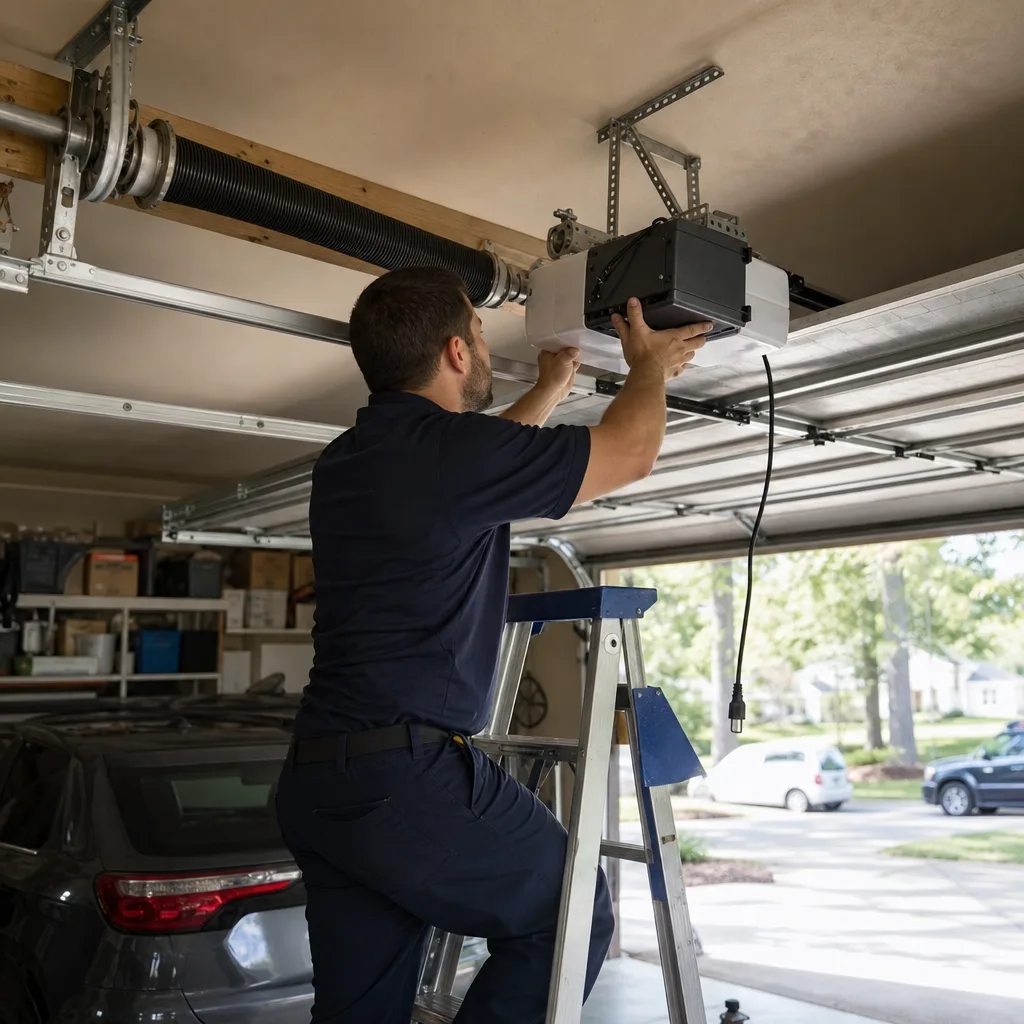
Last updated October 17, 2026
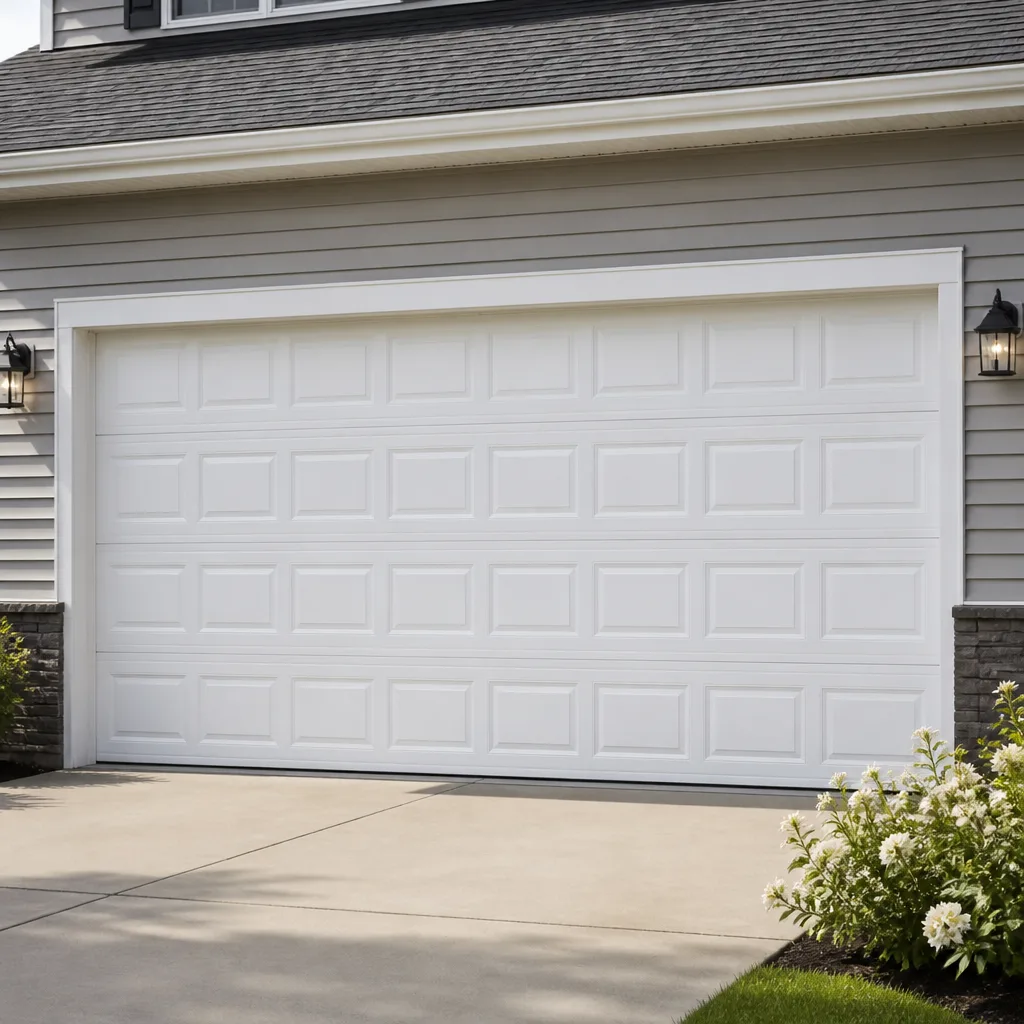 Raised-panel steel
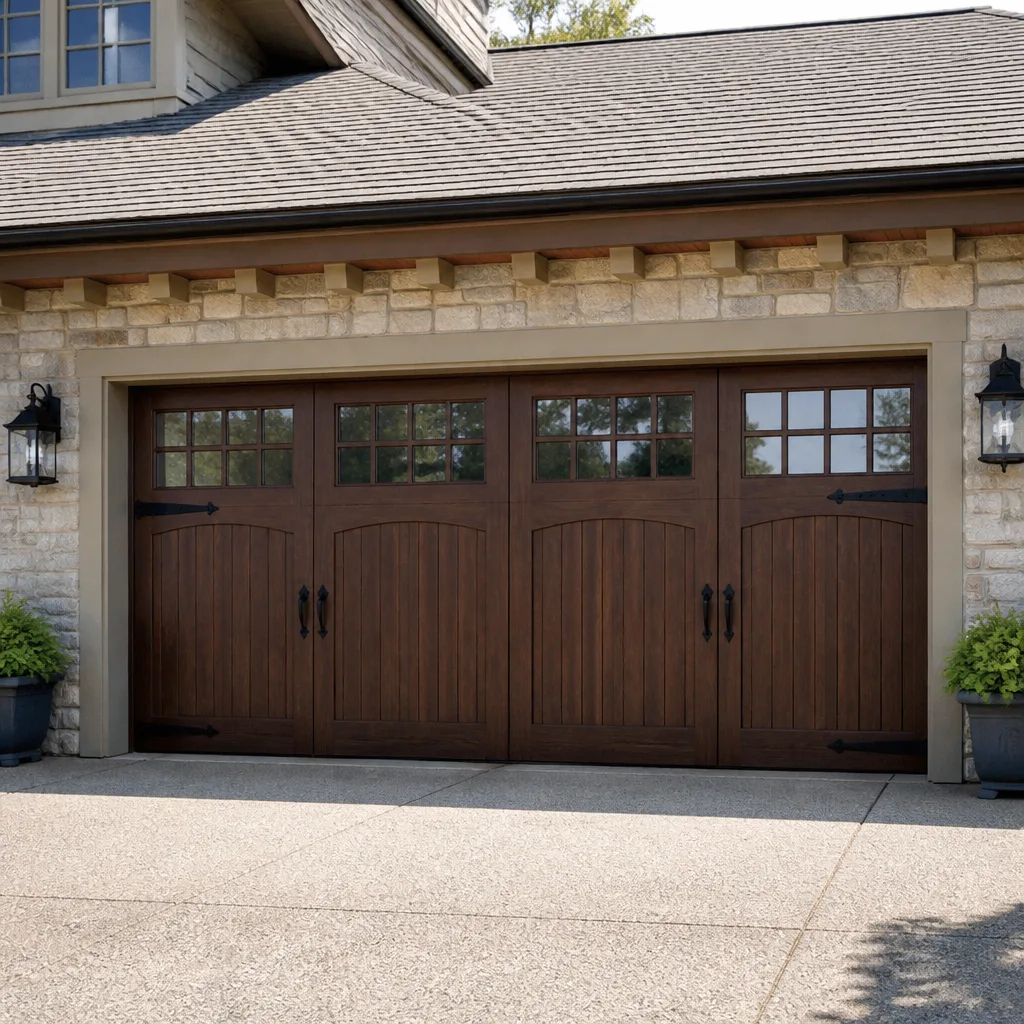 Carriage house
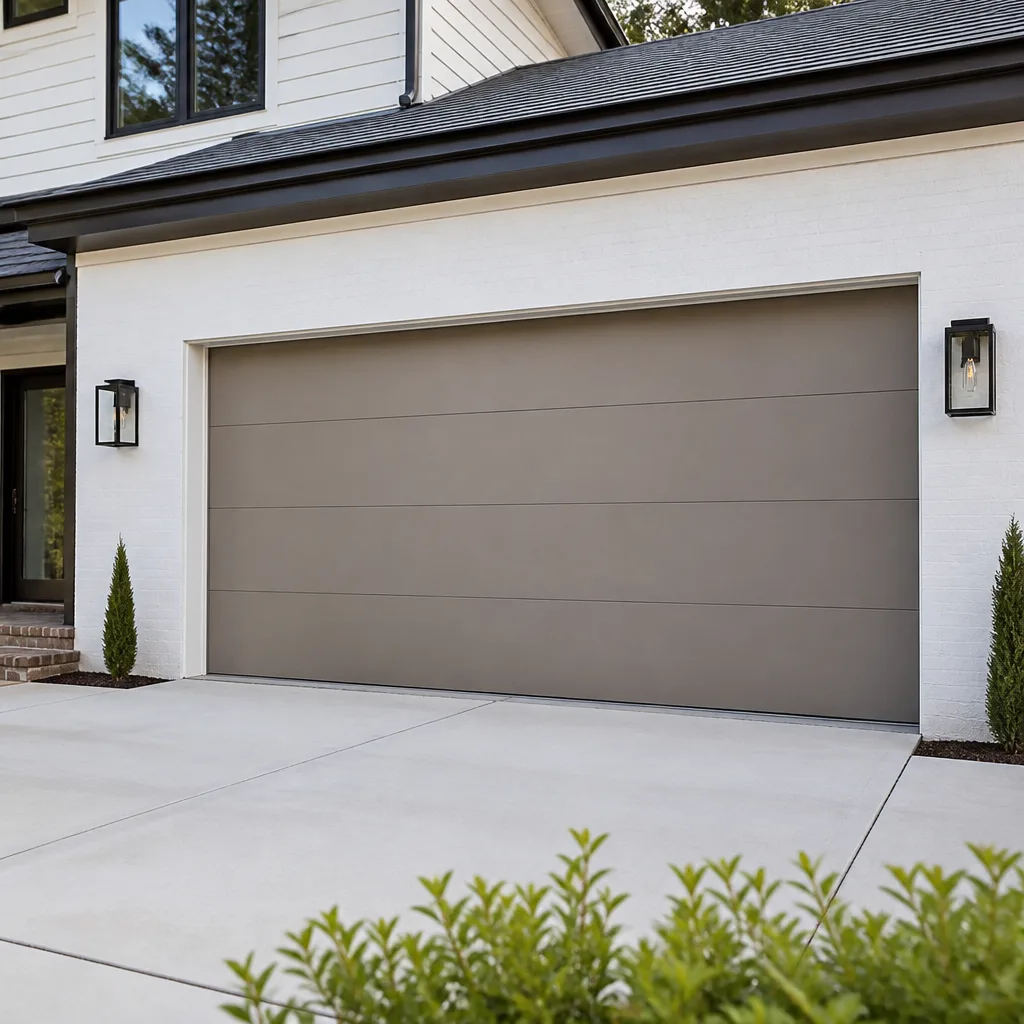 Modern flush
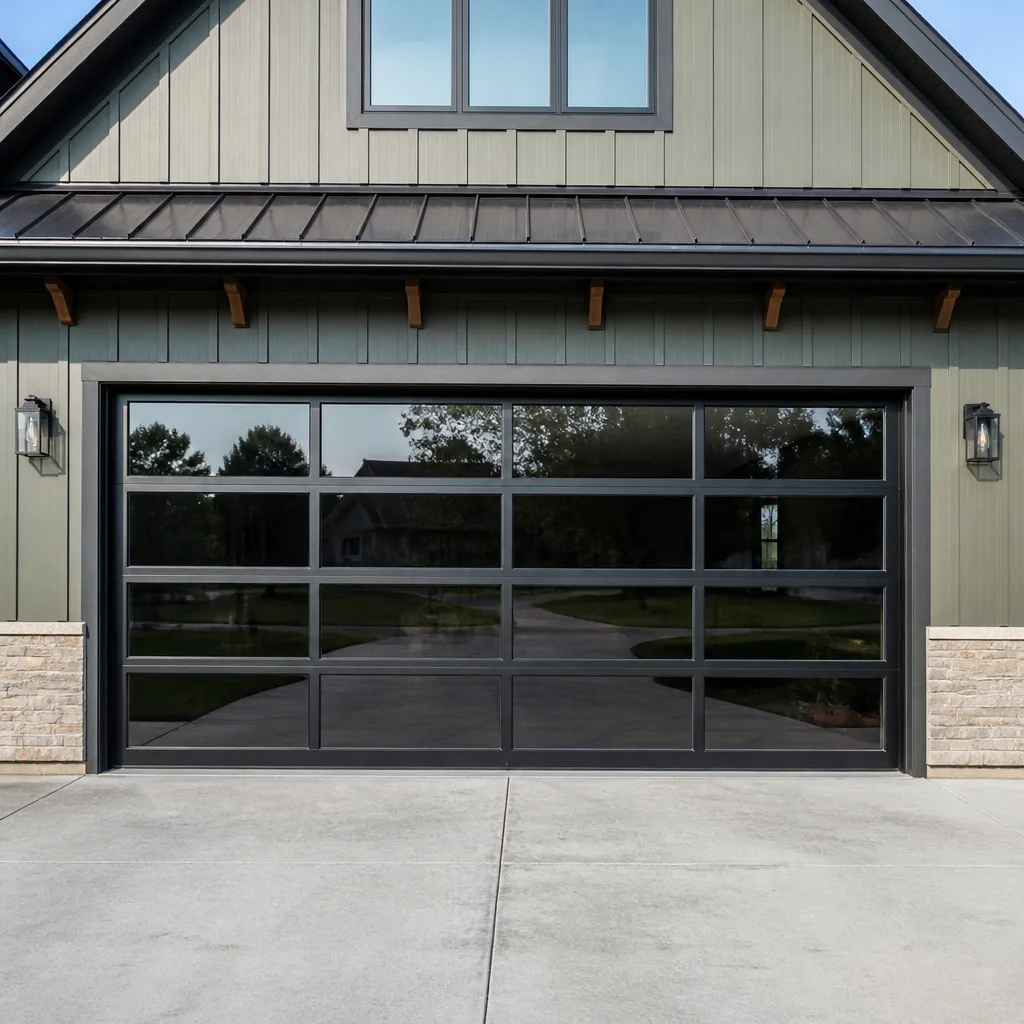 Full-view glass
 LiftMaster openers
 Chamberlain openers
Full 25-point door and opener safety check with every visit - springs, cables, rollers, tracks, and your LiftMaster or Chamberlain opener included
You get a price before we start. It does not change when the truck arrives.
Get your free estimateDIY vs Professional Garage Door: The Sandy Springs Homeowner’s Decision Guide
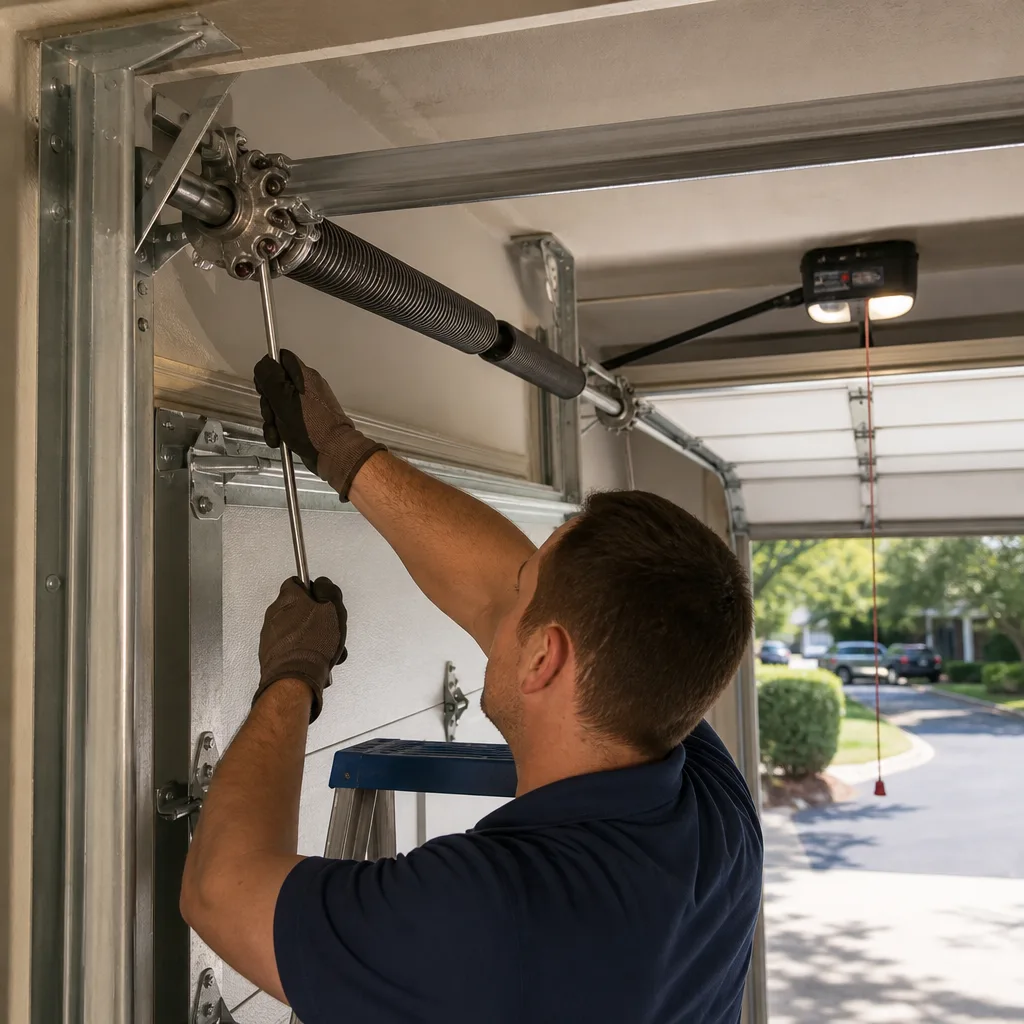
Torsion spring replacement causes more home-repair injuries per task than nearly any other common fix, not because homeowners aren’t capable, but because the stored tension in a standard spring is equivalent to several hundred pounds of force released in under a second. A single slipped winding bar can send a steel rod through drywall, a car windshield, or a hand. This guide is written for Sandy Springs homeowners who want to know exactly where that line sits: which garage door tasks are genuinely safe to handle on a Saturday morning, and which ones should never be attempted without a trained technician, the right tools, and a written price agreed before the work begins. For a complete maintenance checklist Sandy Springs homeowners can follow, see our companion resource. By the end, you’ll know what to grab from the hardware store, what to leave alone, and how to think about the costs on both sides of the decision.
Quick Answer
Most Sandy Springs homeowners can safely handle lubrication, sensor realignment, remote reprogramming, and weatherstripping replacement themselves. Spring replacement, cable work, track repair, and any task involving the bottom bracket bolts should go to a professional, not because you lack the skill, but because those components hold hundreds of pounds of stored tension and the consequences of a mistake are severe. If you’re unsure where your task falls, call (912) 348-5341 and a live person will help you think it through before you touch anything.
Styles & brands we work with
Table of Contents
- The Real Risk Map: What Hurts People and What Doesn’t
- Safe DIY Tasks: What You Can Confidently Handle
- Never DIY: The Four Tasks That Require a Professional
- The Georgia Liability Question: Insurance, Permits, and Your Home
- How to Assess Your Door Before Deciding
- What a Professional Visit Actually Buys You
- The Middle Path: Pre-Diagnose to Save Time and Money
- Cost Comparison: DIY vs Professional in Sandy Springs
The Real Risk Map: What Hurts People and What Doesn’t
Garage door injuries in Sandy Springs follow a predictable pattern. Emergency room data from around Atlanta consistently shows the same three causes: torsion springs under tension, cables that snap while under load, and panels that fall when the track is misaligned. What rarely sends anyone to the hospital is the stuff that annoys people daily: a noisy door, a remote that won’t pair, a sensor that blinks, or weatherstripping that’s gone brittle.
The distinction matters more than most homeowners realize. A garage door that won’t open feels like one big broken machine, but it’s actually a set of separate systems: the spring assembly that counterbalances the weight, the cables that transfer that force, the tracks and rollers that guide movement, and the opener motor and sensors that control it. Only two of those four systems hold dangerous stored energy. The other two are mostly mechanical adjustments any patient homeowner can handle.
Here’s the risk breakdown we use when talking to Sandy Springs homeowners:
- Springs (torsion or extension): High risk. Hundreds of pounds of stored tension. Never a DIY task.
- Cables and bottom bracket bolts: High risk. They work directly with the springs and can release without warning.
- Track and roller replacement: Moderate risk. Requires removing panels or working at height with heavy sections.
- Opener motor replacement: Low-to-moderate risk. Electrical and ladder work involved, but no stored spring tension.
- Sensor alignment and remote programming: Low risk. No force involved. Safe for most homeowners.
- Lubrication and weatherstripping: Low risk. Routine maintenance that takes under an hour.
What surprises most people is how quickly a “simple” task can escalate when the door is older or the spring type is unfamiliar. We’ll get into that assessment process later in this guide.
Safe DIY Tasks: What You Can Confidently Handle
Not every garage door problem needs a service call. Some of the most common complaints we hear from Sandy Springs homeowners have fixes that take fifteen minutes, cost under thirty dollars, and don’t require touching anything that stores energy. Knowing these tasks well builds confidence and saves real money over the life of the door.
1. Lubricating the rollers, hinges, and tracks
A garage door that sounds like a freight train in the morning is usually just dry metal. Spray a lithium-based or silicone lubricant on the rollers, hinges, and the track where the rollers travel. Don’t use WD-40, which is a solvent, not a lubricant. Do this twice a year, and you’ll extend the life of the rollers and reduce opener strain. Sandy Springs humidity means parts corrode faster here than in drier climates, so twice-yearly lubrication genuinely matters.
2. Realigning photo-eye sensors
When the door reverses immediately after touching the ground, or the opener light blinks, the photo-eye sensors at the bottom of the track are usually misaligned. Loosen the wing nut holding each sensor, adjust the angle until the indicator light stays solid, and retighten. A level helps. This is a zero-risk task that saves you a service call fee every time it works.
3. Reprogramming remotes and keypads
Most remotes for LiftMaster, Chamberlain, and Genie openers use a simple learn-button pairing process. Find the learn button on the motor unit, press it, then press the remote button within thirty seconds. Keypads follow a similar process with a PIN entry. The owner’s manual has the exact steps for your model. If you’ve lost the manual, the brand’s website has digital copies.
4. Replacing bottom weatherstripping
The rubber strip along the bottom of the door cracks and flattens over time, especially with Sandy Springs summer heat. Replacement strips cost $15 to $30 at any hardware store and slide into the existing channel on most doors. Pull out the old strip, slide in the new one, trim to length. You’ll keep out rain, leaves, and the occasional field mouse, and your garage will hold temperature better.
None of these tasks require special tools beyond what most households already have, and none of them put you in contact with springs or cables. If you’re comfortable with a screwdriver and a ladder, you can handle all four.
Never DIY: The Four Tasks That Require a Professional
Somewhere between the internet tutorials and the tool aisle at Home Depot, a reasonable homeowner can talk themselves into a job that has no business being done without training. We want to be direct about these four tasks, not to scare you, but because the physics don’t care about confidence.
1. Torsion spring replacement
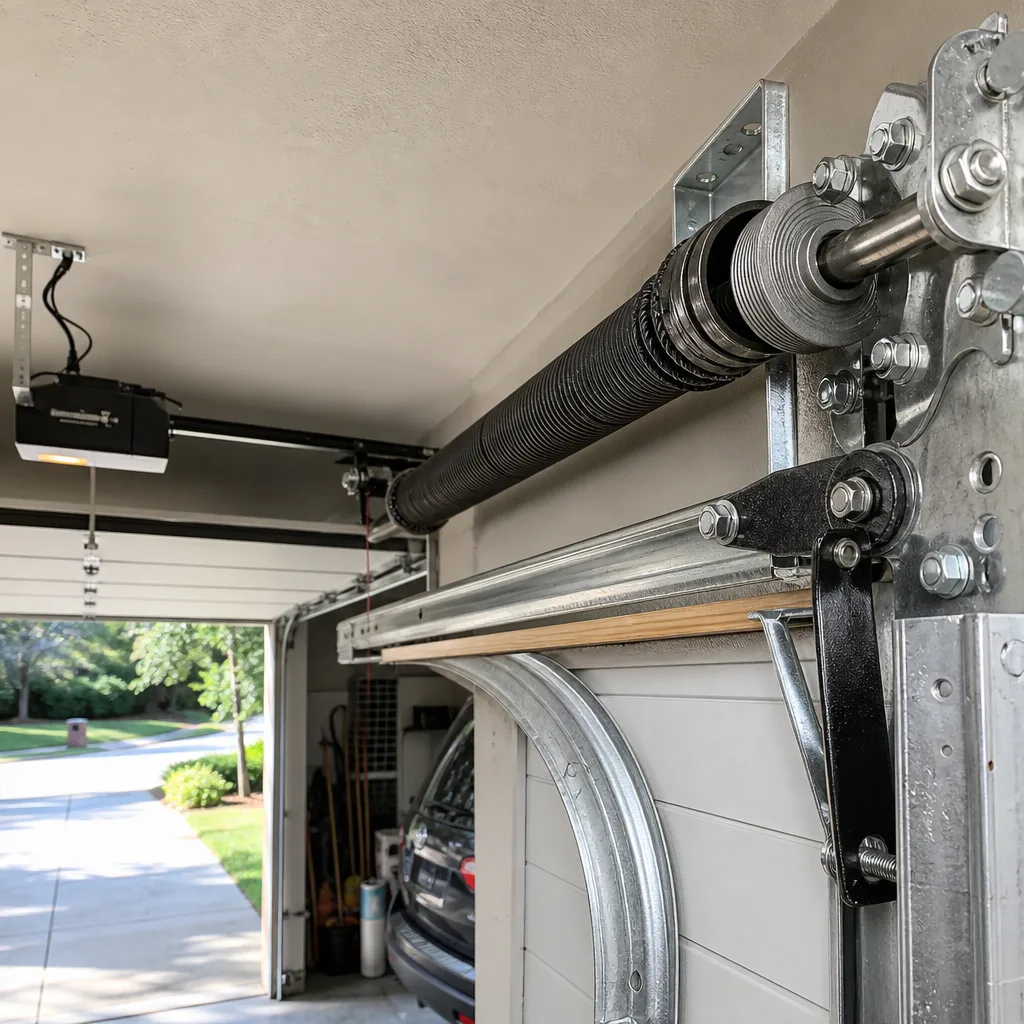
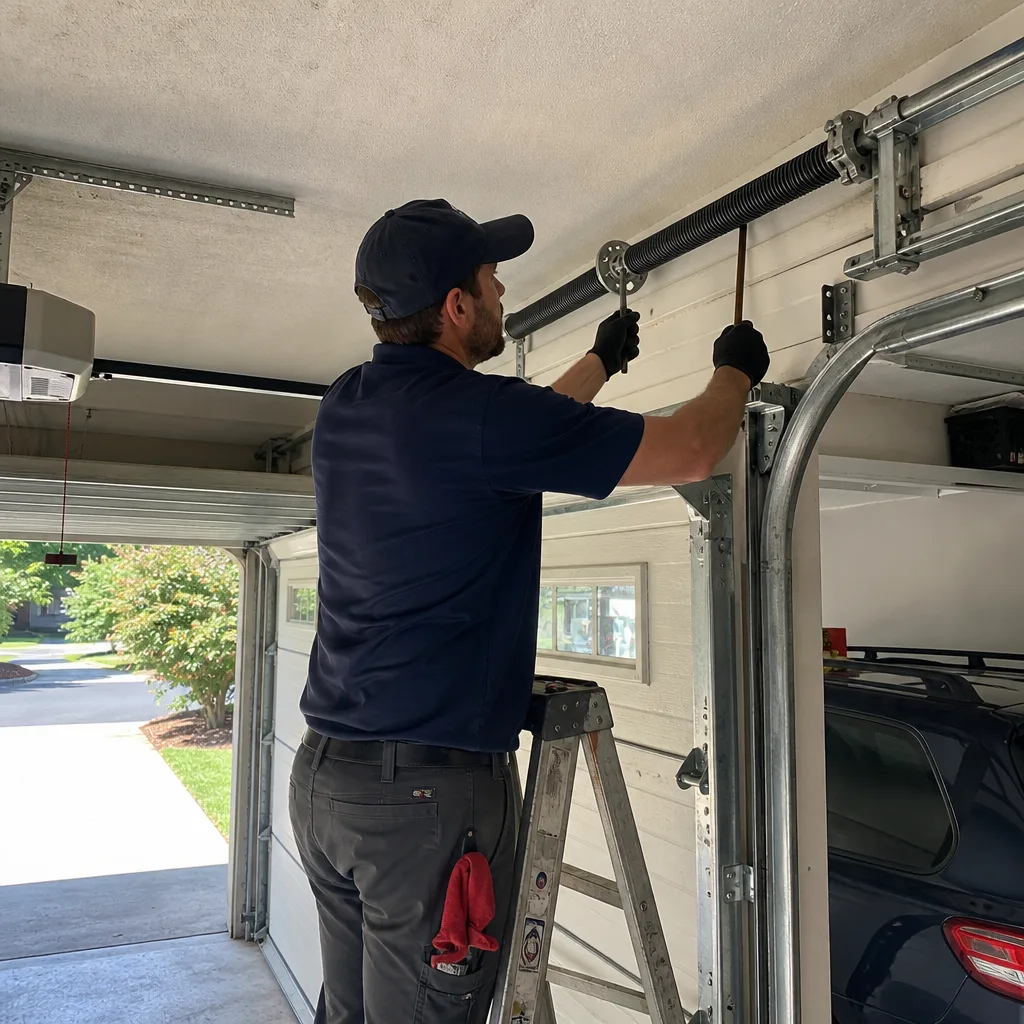
A standard 7-foot residential torsion spring holds enough tension to lift a 150-to-200 pound door. That energy has to be wound into the spring using winding bars inserted into the cone at the end. If a bar slips, the spring unwinds instantly. The bar becomes a projectile. Hands, faces, and anything in the path lose. We’ve replaced springs in Sandy Springs homes where a homeowner’s attempt left a hole in the garage ceiling. The spring itself costs $60 to $120. The professional installation with a written warranty costs $180 to $340. The difference is the training, the right tools, and the fact that a company’s labor warranty covers what happens if the spring breaks prematurely. Call a professional for this one. Period.
2. Cable replacement
The cables run alongside the door and connect the bottom bracket to the spring system. When a cable frays or breaks, the remaining cable holds the full load, and the door can hang unevenly or drop suddenly. Replacing a cable requires releasing spring tension first, which is the dangerous part. If you don’t know exactly how to secure the door and unwind the spring safely, you’re one slip away from a serious injury.
3. Bottom bracket bolt loosening or replacement
This one catches people completely off guard. The bottom bracket bolts attach the cables to the door itself. YouTubers sometimes tell people to loosen these bolts to adjust the door, without mentioning that the bolt holds the cable under full spring tension. Loosen it, and the tension releases through the bolt. Several fingers have been lost this way. Never touch these bolts unless you are a trained technician.
4. Track replacement or major realignment
Track work means removing and rehanging the vertical and horizontal tracks that guide the door. The door panels are heavy, the track must be perfectly aligned, and the springs are often involved in the process. A door that comes off its track during a DIY attempt can fall on a car, a child, or a pet. In Sandy Springs, where many garages serve as workspaces and play areas, the risk isn’t abstract.
If your task involves any of these four, stop and schedule a professional. We’ll talk more about what that visit should look like later in this guide.
The Georgia Liability Question: Insurance, Permits, and Your Home
Here’s a consideration that rarely shows up in DIY guides but matters deeply for Sandy Springs homeowners. If you perform a structural repair on your garage door, and that repair later fails and causes an injury to a family member or a visitor, your homeowners insurance may scrutinize whether the work was done by a licensed, insured professional. We’re not attorneys and this isn’t legal advice, but we’ve seen enough claims conversations to know that self-performed work on springs and cables becomes a problem when the adjuster asks who did the repair.
The specific scenario looks like this: a homeowner replaces a torsion spring in March. The spring or cable fails in July, the door falls, and someone is hurt. The insurance claim is filed. The adjuster asks for documentation showing professional installation. If the answer is “I did it myself,” the claim can be denied or reduced on the grounds that the homeowner lacked the expertise to assess the condition of the door’s other components. In a city like Sandy Springs, where homes are valuable and claims are common, protecting the paper trail matters.
There’s also the code angle. Sandy Springs enforces Georgia building codes, and while garage door repairs don’t typically require a permit, structural modifications or full door replacements can. A professional company knows what the local code requires, particularly for wind load ratings, which matter in a city that gets its share of severe thunderstorm winds off the Chattahoochee corridor. Part of what you buy with professional work is documentation: a receipt, a warranty, and a paper trail that stands up if you ever need it.
How to Assess Your Door Before Deciding
Before you decide whether to grab a screwdriver or pick up the phone, take five minutes to understand what kind of door you’re working with. Age, spring type, and track condition all change the calculation, and skipping this step is how a “simple” fix becomes a complicated one.
Step 1: Determine the spring type
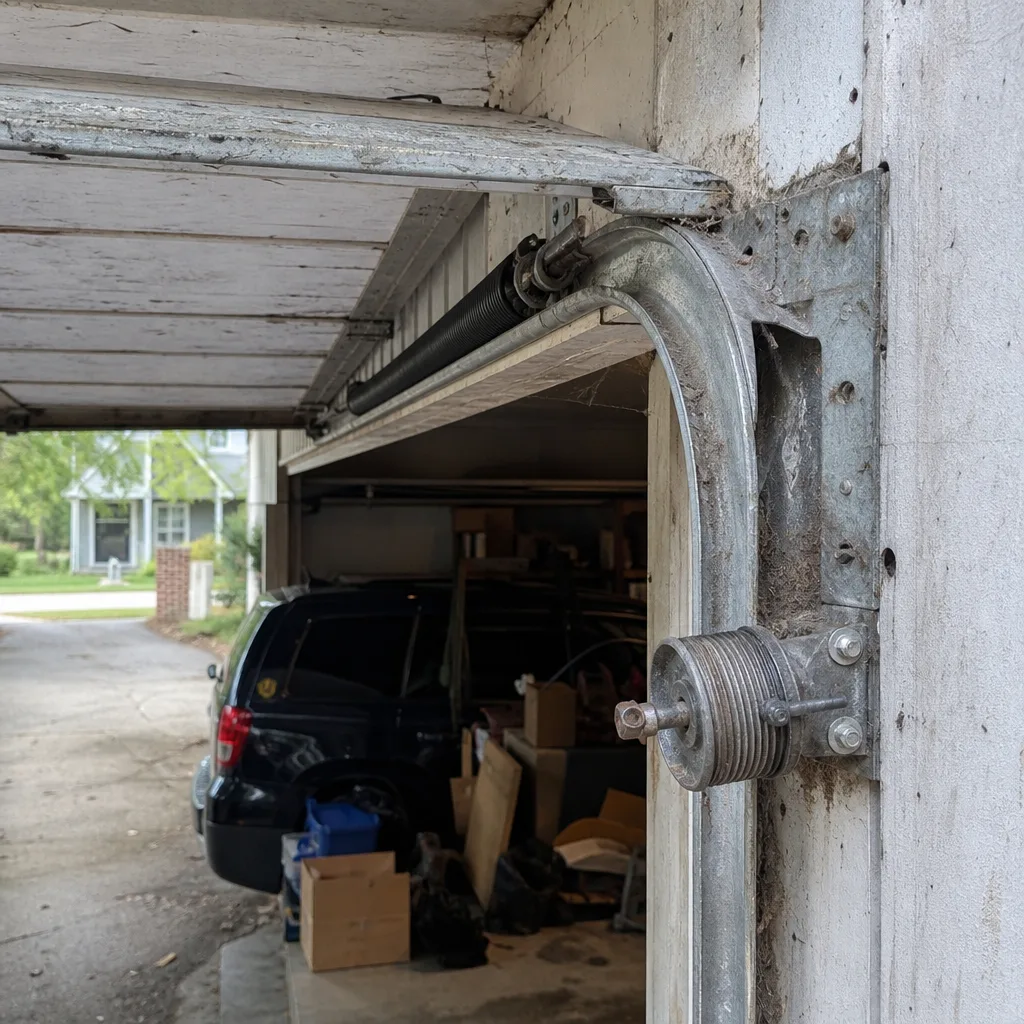
Look above the closed door. If you see a long, thick spring mounted on a metal bar directly above the door opening, that’s a torsion spring. If you see two longer, thinner springs stretched along the horizontal tracks on either side, those are extension springs. Torsion springs are safer for professionals to work with and more common in newer Sandy Springs homes. Extension springs are older technology and more common on doors installed before 2000.
Step 2: Note the door’s age
Find the manufacturer’s sticker on the inside of the door panel. Most doors list the year of manufacture. A door under ten years old with a torsion spring is typically a straightforward repair. A door over twenty years old may have worn rollers, corroded tracks, and a spring that’s near the end of its rated cycle life. That older door is more likely to cascade from a simple fix into a multi-component repair, which is exactly when professional assessment saves money.
Step 3: Inspect the tracks and rollers
Run your hand along the track (with the door closed and the opener disconnected). Feel for dents, gaps, or rust that catches. Watch the rollers as the door moves. Nylon rollers wear out silently, and worn rollers cause the door to bind and shake, which puts strain on other parts. If the track is bent or the rollers are visibly worn, a DIY fix to one component won’t solve the underlying issue.
Step 4: Check the door balance
Pull the emergency release cord and lift the door manually to waist height. A properly balanced door stays in place when you let go. A door that drops or rises on its own has a spring problem, and that spring problem is a professional problem. Balance testing is the single most important diagnostic step, and it tells you more than anything else about the health of the system.
These four checks take about ten minutes and give you the information to make a confident call about what’s safe to tackle.
What a Professional Visit Actually Buys You
Some Sandy Springs homeowners are perfectly capable of doing a DIY task correctly and still choose to call a professional. That’s a rational decision, and it deserves an honest explanation of what the service call fee actually covers beyond the labor.
A written price before work starts. This is the big one. The moment a technician arrives at your home, you should know exactly what the repair will cost, in writing, before a single tool comes out of the truck. If the diagnosis changes once the door is open, you should approve the new number before work continues. This protects you from the worst outcome of any repair: an invoice that’s larger than the quote. Garage Door Repair in Sandy Springs from Fernbrook includes this on every visit, no exceptions.
A labor warranty on the work. When you repair a spring yourself and it breaks again in three months, you bought a second spring. When a professional installs a spring and it fails prematurely, the labor is covered. Our 365-Day Done Right Promise is stamped on every job, which means if it’s not done right, we make it right, with no negotiation required.
Protection for the home, not just the door. A professional visit should leave your garage cleaner than when we arrived. Shoe covers on hardwood, drop cloths on tile, tools kept quiet enough for nap time, and a technician who asks before moving a dog crate or a kids’ bike. We photograph the clean-up before we walk out, so you can see exactly what you’re paying for. That’s the Cedarwell Care Promise, and it’s a specific, enumerable list: written price, shoe covers, drop cloths, quiet tools, pet-safe products where there’s a choice, clean-up photo. You should expect all of it from any company you hire in Sandy Springs.
The paper trail. A professional repair comes with a receipt and a service record tied to your address. That matters for the insurance conversation we discussed earlier, and it matters when you sell the home. Buyers in Sandy Springs ask about garage door condition, and a documented service history is worth something at closing.
You’re also buying expertise across brands. Our technicians are trained on LiftMaster, Chamberlain, Genie, Clopay, Amarr, Wayne Dalton, Craftsman, and Raynor systems. That means when we open your door, we know the parts, the failure patterns, and the right fix without a trial-and-error process.
The Middle Path: Pre-Diagnose to Save Time and Money
There’s a practical middle ground between tackling everything yourself and calling blind. When you pre-diagnose your door before making the phone call, you give the technician a head start, and that often translates to a shorter visit and a smaller bill. Here’s how to prepare.
Step 1: Write down the symptoms precisely
“The door opens halfway and stops” is more useful than “the door is broken.” Note when it happens (first thing in the morning, always after rain, only when it’s cold), what you hear (a bang, a scrape, a hum that stops), and whether the opener light blinks. Specific symptoms narrow the diagnosis considerably.
Step 2: Run the balance test before calling
We described it above. Pull the release cord, lift the door, let go, and note what happens. Tell the person on the phone what you observed. That single piece of information tells us whether we’re dealing with a spring problem or an opener problem, and we’ll bring the right parts on the truck.
Step 3: Clear the workspace
Move cars, bikes, and toys away from the door and the track. Move anything fragile off shelves near the door. A clear workspace means the technician spends time repairing, not moving your belongings, and it’s one less thing to think about during the visit.
Step 4: Have your door’s age and brand ready
The manufacturer’s sticker on the inside panel tells us the year and the model. If you can read it, great. If not, describe the door: wood or steel, one panel or multiple, insulated or not. Every detail narrows the parts list.
When you call (912) 348-5341, a live person answers. Tell them what you’ve observed. We’ll ask a few questions, give you a price range on the phone when we can, and schedule a time that works for your family, not one that works for our route. The pre-diagnosis you’ve done makes that conversation shorter and more accurate.
Cost Comparison: DIY vs Professional in Sandy Springs
The table below shows typical price ranges for both approaches. DIY costs are parts only, assuming you already own basic tools. Professional costs are parts plus labor from a licensed, insured company in Sandy Springs, with a written warranty on the work.
| Task | DIY Parts Cost | Professional Cost | Risk Level |
|---|---|---|---|
| Lubrication | $10 – $20 | $75 – $125 | Low |
| Sensor realignment | $0 | $75 – $125 | Low |
| Remote reprogramming | $0 | $50 – $90 | Low |
| Weatherstripping replacement | $15 – $30 | $90 – $150 | Low |
| Roller replacement | $40 – $80 | $150 – $250 | Moderate |
| Opener motor replacement | $180 – $300 | $350 – $600 | Moderate |
| Torsion spring replacement | $60 – $120 | $180 – $340 | High |
| Cable replacement | $30 – $60 | $150 – $250 | High |
| Bottom bracket work | $20 – $40 | $150 – $250 | High |
| Full door replacement | $800 – $1,500 | $1,500 – $4,000 | High |
The DIY savings on low-risk tasks are real and worth pursuing. The savings on high-risk tasks are not worth the potential cost of an injury or a failed repair that damages other components. One important note on professional pricing in Sandy Springs: the price we quote is the price you pay. It’s written down before work starts, and we don’t add fees once the door is open. If your technician finds a second problem, we show you the new number and get your approval before continuing. That’s how every visit works.
Common Mistakes to Avoid
- Loosening the bottom bracket bolts based on a video tutorial. These bolts hold cable tension. Loosening one releases the spring’s stored energy through the bolt and has caused serious hand injuries in Sandy Springs garages. Never touch them.
- Using the wrong lubricant. WD-40 strips the protective grease from rollers and hinges, which accelerates wear. Use a lithium or silicone lubricant designed for garage doors.
- Ignoring a door that’s slightly off balance. A door that drifts down at waist height is telling you the spring is weakening. Waiting until it fails means a spring replacement becomes an emergency call instead of a scheduled appointment.
- Replacing only one spring on a two-spring door. Both springs wear at the same rate. Replacing one leaves the door unbalanced and shortens the life of the new spring. This is a professional-only task anyway, but if a technician suggests replacing only one, ask why.
- Forcing a door that’s binding. If the door resists movement or the opener strains, forcing it risks damaging the track, the panels, and the opener motor. Stop and diagnose before pushing further.
- Assuming an older door is safe to DIY because it’s “simple.” Doors installed before 2000 often use extension springs, which have their own failure risks, and the hardware on a 25-year-old door is more likely to have hidden corrosion. Age changes the safety calculation.
- Skipping the insurance conversation. If you self-perform a structural repair and it fails, your insurance company may ask uncomfortable questions. The documented professional repair protects you. It’s not about skill; it’s about the paper trail.
See the difference
 Before
 After
After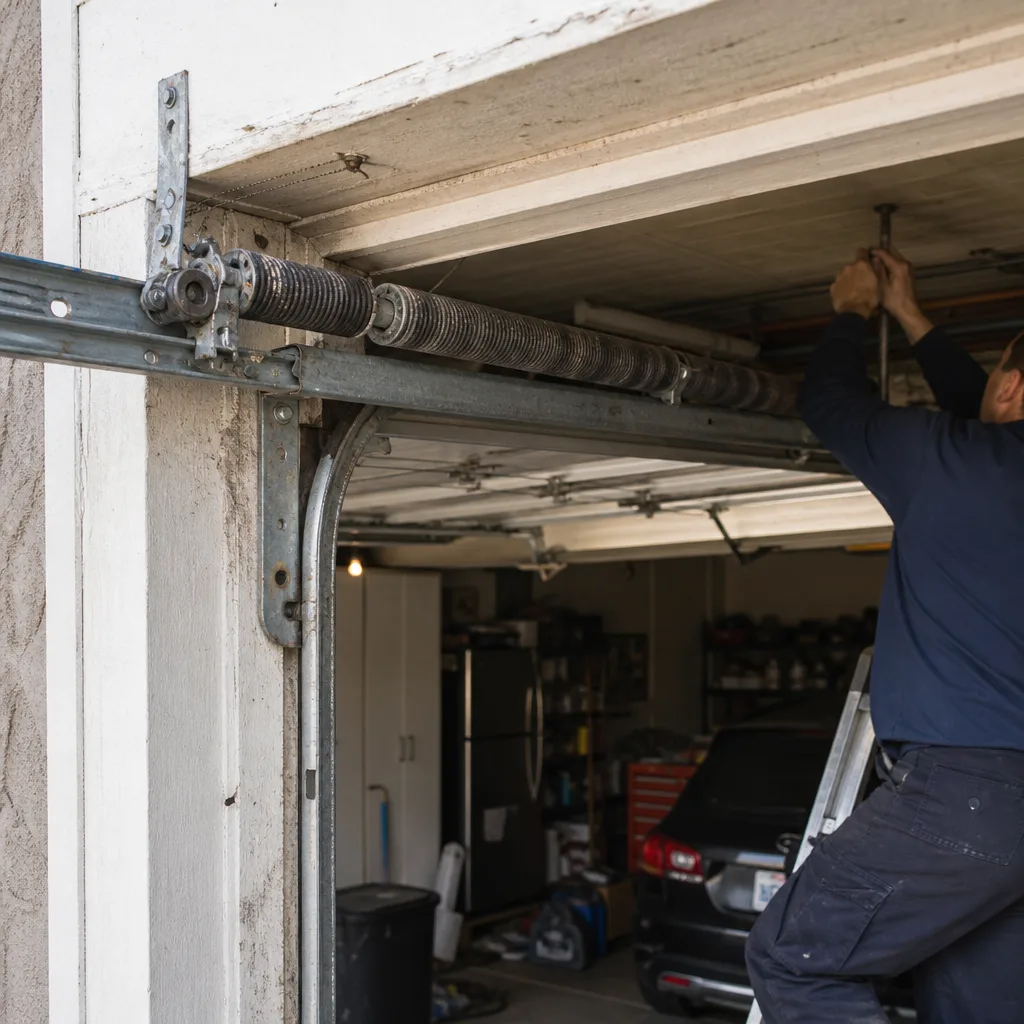 Before
 After
After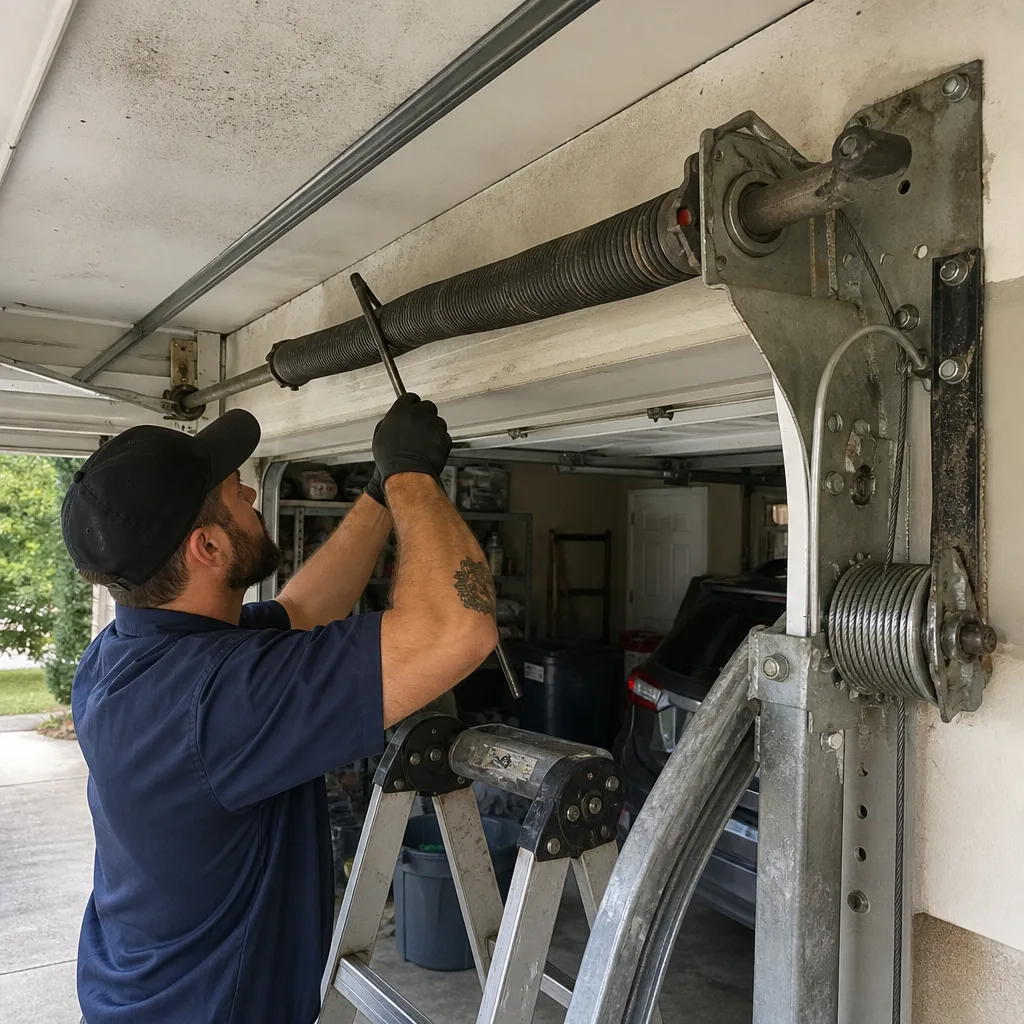 Before
 After
AfterWhen to Call a Professional
Call a professional if your door has a broken spring, a frayed or snapped cable, a bottom bracket that’s come loose, a track that’s bent or pulling away from the wall, or any problem that involves removing panels or working at height with heavy sections. Call if you’ve run through the DIY tasks and the door still isn’t operating correctly, or if you’re simply not comfortable with a ladder and tools near a moving mechanical system. There’s no shame in that, and honestly, the peace of a documented repair with a labor warranty is worth the service call fee for most Sandy Springs families. Fernbrook Garage Doors Sandy Springs offers free estimates in Sandy Springs, call (912) 348-5341 and a live person will help you determine what you’re dealing with before you touch anything.
Frequently Asked Questions
Torsion spring replacement in Sandy Springs typically costs $180 to $340 including parts and labor, depending on the spring size and whether you have one spring or two. The price is quoted and agreed before any work starts, so you’ll know the exact number before a tool comes out. Call (912) 348-5341 for a free estimate and a specific quote for your door.
You physically can, but you shouldn’t. The winding process requires specialized bars and the stored tension is enough to cause serious injury if a bar slips. Most Sandy Springs homeowners who attempt this end up calling a professional after the door is half-dismantled, and the repair costs more in that state than it would have originally. This is the one task where the DIY savings are never worth the risk.
No. A written price is delivered before any work begins, and that number stays the number unless we find an additional issue that requires a new quote and your approval. You will never receive an invoice that’s larger than the written quote without an explicit conversation first.
Yes. Our service vehicles carry springs, cables, rollers, sensors, and opener parts for the most common door brands in Sandy Springs, including LiftMaster, Chamberlain, and Craftsman. When you call and describe your symptoms, we’ll know what to bring, and in most cases the repair is completed on the first visit.
The repair itself is contained to the door and track, but we take specific precautions: pet-safe lubricants where there’s a choice, quiet tools to avoid startling anyone, and technicians who ask before moving a dog crate, a bike, or anything else in the work area. The working door is the minimum. The house should feel untouched when we leave.
Yes. Our live-person dispatch line is answered 24 hours a day, 7 days a week, and same-day appointments are available for most spring, cable, and opener repairs in Sandy Springs. Call (912) 348-5341 and tell us what you’re seeing. We’ll give you a straight answer about timing and a price range before you hang up.
The Bottom Line
The DIY-versus-professional question for garage doors has a clean answer: do the low-risk maintenance tasks yourself and save the money; hire a professional for anything involving springs, cables, bottom brackets, or track work. Sandy Springs homeowners have the added consideration of Georgia insurance realities, where documented professional repairs protect claims and resale value. What a professional visit buys beyond the repair is written pricing, a labor warranty, and a workspace that’s protected while the work happens and clean when it’s done. The door opening again is table stakes. You should expect more.
If you’re ready to tackle a safe DIY task, we hope this guide gave you the confidence to do it well. If you’re up against a spring, a cable, or a door that’s fighting you, call Fernbrook Garage Doors Sandy Springs at (912) 348-5341. A live person will answer, ask the right questions, and get you scheduled. You’ll get a written price before any work starts. That’s how every job should work, and it’s how ours always do.
Written by Jesse Calder, Owner at Fernbrook Garage Doors Sandy Springs, serving Sandy Springs since 2002.